Material Coverage Reference
Almost nothing is sold in the unit you measured. You work out a room in square feet and the shelf offers you bags, boxes, sheets, rolls, gallons and bundles. The figure that closes that gap — what one package actually covers — is the number this page collects.
Every figure below is the one the matching calculator uses, and this page is generated from those calculators rather than typed alongside them, so the two cannot drift apart. Where a range is given, it is because the real answer depends on something: the texture of the wall, the notch on your trowel, the depth you spread it at.
The figure on the package you are holding always wins. These are standard sizes and typical rates for planning. Check the bag before you divide.
The ones people look up most
| Question | Answer | Work it out |
|---|---|---|
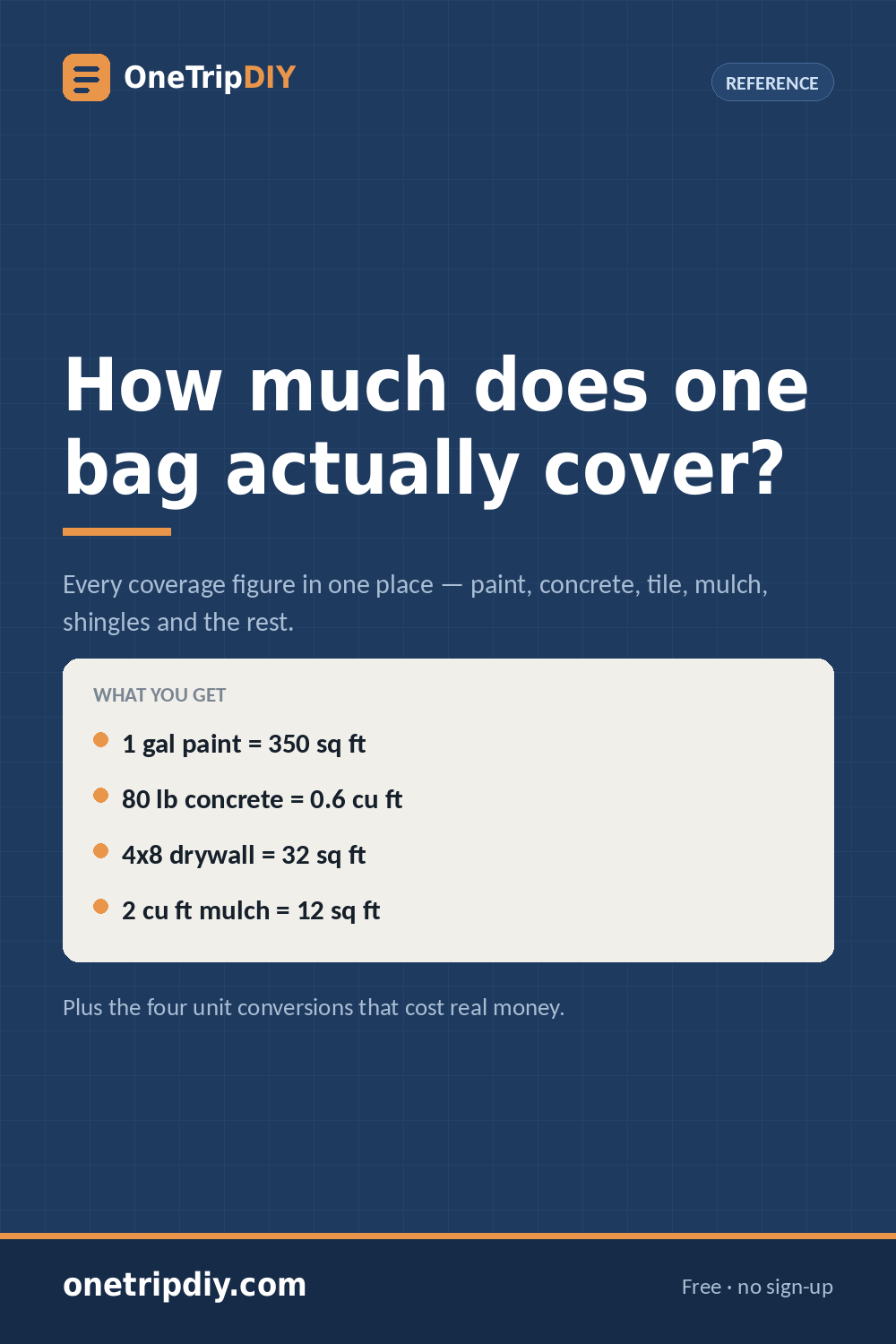
| One gallon of paint | 350 sq ft, one coat, on a typical wall | Paint calculator |
| One 80 lb bag of concrete | 0.6 cu ft — 45 bags to a cubic yard | Concrete slab calculator |
| One 4 × 8 ft sheet of drywall | 32 sq ft | Drywall calculator |
| One 2 cu ft bag of mulch | 12 sq ft at 2 in. deep, 8 at 3 in. | Mulch calculator |
| One bundle of shingles | a third of a square — 3 bundles cover 100 sq ft | Roof shingles calculator |
| One 50 lb bag of thinset | about 95 sq ft with a 1/4 in. notch trowel | Tile calculator |
| One 12 × 12 in. tile | exactly 1 sq ft — 144 sq in. ÷ 144 | Tile calculator |
| One pallet of sod | 450 sq ft on the common US pallet | Sod calculator |
Each row links to the calculator that uses that figure, which will do the division for you.
Paint and primer
Paint coverage is the most optimistic number in the building trade. "Up to 400 square feet per gallon" is measured on a smooth, sealed, primed surface by somebody who does it for a living. Texture is the variable nobody accounts for — a textured wall has more actual surface than its measured area, which is what texture means.
| Surface | Per gallon, one coat |
|---|---|
| Smooth, previously painted | 400 sq ft |
| Typical wall | 350 sq ft |
| Textured or porous | 300 sq ft |
| Primer on bare drywall | 200–300 sq ft |
| Rough masonry, block, stucco | 150–200 sq ft |
Multiply by the number of coats. Two coats is standard; three over bare board or a color change.
| Opening | Deduct |
|---|---|
| A standard door | about 21 sq ft |
| A standard window | about 12 sq ft |
Under about 20 sq ft, do not deduct at all — the waste from cutting around it eats the difference.
Drywall, compound and tape
| Sheet | Covers |
|---|---|
| 4 × 8 ft | 32 sq ft |
| 4 × 10 ft | 40 sq ft |
| 4 × 12 ft | 48 sq ft |
On a wall longer than 8 ft, 12 ft sheets mean one butt joint instead of two — less compound and far less sanding.
| What else | How much |
|---|---|
| Screws | about 32 per sheet |
| Joint compound | roughly 1 gallon per 105 sq ft, over three coats |
| Joint tape | about 0.4 linear ft per sq ft of board |
All three come out of the drywall calculator along with the sheets.
Tile, thinset and grout
Tile face area is square inches divided by 144. That division is the single most common arithmetic mistake in material estimating — get it wrong and you can be out by a factor of two.
| Tile | Each covers |
|---|---|
| 3 × 6 in. subway | 0.125 sq ft |
| 4 × 12 in. | 0.33 sq ft |
| 12 × 12 in. | 1 sq ft |
| 12 × 24 in. | 2 sq ft |
| 18 × 18 in. | 2.25 sq ft |
| 24 × 24 in. | 4 sq ft |
Boxes vary far more than tiles do. Two boxes of 12 × 12 from different makers can hold 15 sq ft and 11.
| Material | Coverage |
|---|---|
| Thinset, 50 lb bag | 95 sq ft at a 1/4 in. square-notch trowel |
| Thinset, 12 in. tile | about 60 sq ft — bigger notch, less coverage |
| Thinset, large format | about 40 sq ft — 1/2 in. notch |
The trowel notch decides thinset coverage, not the bag. The same shower can need two bags or four.
Grout is the figure that varies most, because it depends on joint length rather than area. Big tiles with narrow joints use very little; mosaic uses several times as much over the same floor.
| Tile | Grout | Per 10 lb bag |
|---|---|---|
| 12 in. and up, 1/8 in. joints | about 1 lb per 9 sq ft | about 90 sq ft |
| 6 in., 1/8 in. joints | about 1 lb per 5 sq ft | about 50 sq ft |
| 3 × 6 in. subway, 1/16 in. | about 1 lb per 5 sq ft | about 50 sq ft |
| Mosaic sheets | about 1 lb per 2.5 sq ft | about 25 sq ft |
This is why the shower calculator allows roughly double the plain-floor rate — a shower has a mosaic pan and a niche, so far more joint length per square foot.
Flooring, carpet and wallpaper
| Material | Coverage |
|---|---|
| Laminate, per box | usually 18–24 sq ft |
| Vinyl plank, per box | often 24–30 sq ft |
| Underlayment roll | 100 sq ft |
| Carpet roll — 12 ft | the standard |
| Carpet roll — 15 ft | less common, fewer seams |
| Carpet roll — 13.5 ft (4 m) | imported |
Carpet is bought by the linear yard off a fixed-width roll, so the waste is set by the room, not by a percentage. A linear yard of 12 ft goods is 36 sq ft.
| Wallpaper roll | Size |
|---|---|
| US double roll | 27 in. wide × 27 ft |
| European roll | 20.5 in. wide × 33 ft |
| US single roll | 27 in. wide × 13.5 ft |
The pattern repeat, not the roll size, is what usually decides how many you need.
Concrete
Concrete is sold by the cubic yard on a truck and by the cubic foot in a bag, and the two are far apart: a cubic yard is 27 cubic feet. Somewhere around one cubic yard is where ready-mix starts winning on both price and effort.
| Bag | Yields | Per cubic yard |
|---|---|---|
| 80 lb | 0.6 cu ft | 45 bags |
| 60 lb | 0.45 cu ft | 60 bags |
| 50 lb | 0.375 cu ft | 72 bags |
| 40 lb | 0.3 cu ft | 90 bags |
Forty-five 80 lb bags is over a ton of material to lift, open and mix before the first batch starts going off.
Mulch, gravel and topsoil
Loose material is sold by volume but spread to a depth, and depth is the measurement people estimate. Plan two inches and spread three and you are 50% short before you finish the first bed.
| Bag | At 2 in. deep | At 3 in. | At 4 in. |
|---|---|---|---|
| 2 cu ft | 12 sq ft | 8 sq ft | 6 sq ft |
| 3 cu ft | 18 sq ft | 12 sq ft | 9 sq ft |
| 1.5 cu ft | 9 sq ft | 6 sq ft | 4.5 sq ft |
A cubic yard is 27 cu ft — thirteen and a half of the standard 2 cu ft bags.
| Aggregate | Weight |
|---|---|
| Crushed stone / #57 | about 1.4 tons per cu yd |
| Pea gravel | about 1.35 tons per cu yd |
| Crusher run / road base | about 1.5 tons per cu yd |
| River rock | about 1.25 tons per cu yd |
| Decomposed granite | about 1.3 tons per cu yd |
Suppliers often quote by the ton and you calculated in cubic yards. Ask them to convert rather than doing it yourself.
Roofing
A roof is always bigger than the house under it. Multiply the flat footprint by the pitch multiplier to get the true sloped area — it is pure geometry, with no allowance built in.
| Pitch | Multiplier | 1,500 sq ft footprint becomes |
|---|---|---|
| 3/12 | 1.031 | 1,546 sq ft |
| 4/12 | 1.054 | 1,581 sq ft |
| 5/12 | 1.083 | 1,624 sq ft |
| 6/12 | 1.118 | 1,677 sq ft |
| 7/12 | 1.158 | 1,737 sq ft |
| 8/12 | 1.202 | 1,803 sq ft |
| 9/12 | 1.250 | 1,875 sq ft |
| 10/12 | 1.302 | 1,953 sq ft |
| 12/12 | 1.414 | 2,121 sq ft |
| Material | Coverage |
|---|---|
| Shingle bundle | a third of a square — 3 bundles per 100 sq ft |
| Roofing nails | about 320 per square |
| Starter strip roll | about 100 linear ft |
| Shingle underlayment roll | 4 squares |
| Metal roof screws | about 80 per square |
| Synthetic underlayment roll | 1000 sq ft |
| Metal panel | Covers |
|---|---|
| 36 in. | standard exposed fastener |
| 24 in. | standing seam |
| 16 in. | narrow standing seam |
| 26 in. | corrugated, after overlap |
| 12 in. | narrow architectural |
Coverage width, not sheet width. A 39 in. sheet usually covers 36 once it laps its neighbor — order on the sheet width and you will be about 8% short.
Framing and insulation
| Stud spacing | Why |
|---|---|
| 16 in. on center | standard |
| 24 in. on center | advanced framing |
| 12 in. on center | heavy load |
Sheet goods come in 4 ft widths, and 48 divides evenly by 16 and by 24. That is the whole reason.
| Blown insulation | R-value and bag |
|---|---|
| Blown cellulose | R-3.5 per inch, 16 cu ft per bag |
| Blown fiberglass | R-2.5 per inch, 40 cu ft per bag |
R-value is cumulative — four inches at R-3.5 per inch gives you R-14. Recommended attic levels run from about R-30 in the far south to R-60 in the north.
Lawn
| Sod | Covers |
|---|---|
| 450 sq ft | the common US pallet |
| 500 sq ft | |
| 400 sq ft | |
| Big roll | 2 × 5 ft (10 sq ft) |
| Slab | 16 × 24 in. (2.67 sq ft) |
| Small roll | 1.5 × 3.3 ft (5 sq ft) |
| Grass seed, new lawn | Per 1,000 sq ft |
|---|---|
| Tall fescue | 7 lb per 1,000 sq ft |
| Perennial ryegrass | 7.5 lb |
| Kentucky bluegrass | 2.5 lb |
| Fine fescue | 4.5 lb |
| Bermuda (hulled) or Zoysia | 1.5 lb |
| Cool season blend | 5 lb |
Halve these for overseeding. Rates differ this much because seed size does — there are roughly two million Kentucky bluegrass seeds in a pound and about 220,000 tall fescue.
| Also | Rate |
|---|---|
| Starter fertilizer | about 5 lb per 1,000 sq ft |
| Straw | one bale per 750 sq ft — thin enough to still see soil |
The four conversions that cost money
Almost every serious over- or under-order comes from a unit, not a measurement.
| Trap | The conversion | What it looks like when you get it wrong |
|---|---|---|
| Square inches are not square feet | divide by 144 | A 4 × 8 in. paver is 32 sq in. ÷ 144 = 0.22 sq ft. Read it as 0.44 and you order half a patio. |
| Cubic feet are not cubic yards | divide by 27 | A cubic yard is 27 cu ft — 13.5 standard mulch bags, or 45 bags of 80 lb concrete. |
| Linear yards are not square yards | multiply by the roll width ÷ 3 | A linear yard of 12 ft carpet is 4 square yards. Two quotes in different units are not comparable. |
| Weight is not volume | ask the supplier to convert | A ton of gravel is roughly 0.7 cubic yards, and it varies with the stone. |
Masonry
Brick and block are sized so that the unit plus its mortar joint comes to a round number.
| Unit | Face with 3/8 in. joint | Per sq ft | Mortar |
|---|---|---|---|
| Modular brick | 8 × 2 5/8 in. — 21 sq in. | 6.86 | One 80 lb bag lays about 33 |
| Standard brick | 8 3/8 × 2 5/8 in. — 22 sq in. | 6.55 | About 35 to a bag |
| Queen brick | 8 × 3 1/8 in. — 25 sq in. | 5.76 | About 40 to a bag |
| King brick | 10 × 3 in. — 30 sq in. | 4.8 | About 47 to a bag |
| Utility brick | 12 × 4 in. — 48 sq in. | 3 | About 75 to a bag |
| Concrete block, 8 × 16 face | 8 × 16 in. — 128 sq in. | 1.125 | One 80 lb bag lays about 12 |
| Long block, 8 × 24 face | 8 × 24 in. — 192 sq in. | 0.75 | About 8 to a bag |
Divide 144 by the face area in square inches. Block thickness does not change the count — a 6 in. and an 8 in. block cover the same wall.
| Job | Figure | Where it comes from |
|---|---|---|
| Filling 8 in. block cores, all of them | about 1.1 cu yd per 100 sq ft of wall | A hollow block is a little over half solid |
| Filling every fourth core | about 0.37 cu yd per 100 sq ft | Rebar at 32 in. centers |
| Brick veneer wall ties | one per 2.67 sq ft | 16 in. vertical × 24 in. horizontal |
| Weight of a single-wythe brick wall | about 40 lb per sq ft of face | Before the footing carries it |
Cladding and boards
Coverage is exposure × length ÷ 12. The lapped edge does no covering.
| Product | Actual width | Exposed | One 12 ft piece covers |
|---|---|---|---|
| 1 × 4 shiplap | 3 1/2 in. | 3 1/8 in. | 3.13 sq ft |
| 1 × 6 shiplap | 5 1/2 in. | 5 in. | 5.00 sq ft |
| 1 × 6 nickel gap | 5 1/2 in. | 5 1/8 in. | 5.13 sq ft |
| 1 × 8 shiplap | 7 1/4 in. | 6 7/8 in. | 6.88 sq ft |
| 1 × 8 tongue and groove | 7 1/4 in. | 7 in. | 7.00 sq ft |
| 5 1/4 in. fiber cement siding | 5 1/4 in. | 4 in. | 4.00 sq ft |
| 6 1/4 in. fiber cement siding | 6 1/4 in. | 5 in. | 5.00 sq ft |
| 7 1/4 in. fiber cement siding | 7 1/4 in. | 6 in. | 6.00 sq ft |
| 8 1/4 in. fiber cement siding | 8 1/4 in. | 7 in. | 7.00 sq ft |
| 9 1/4 in. fiber cement siding | 9 1/4 in. | 8 in. | 8.00 sq ft |
| 12 in. fiber cement siding | 12 in. | 10 3/4 in. | 10.75 sq ft |
Anything that laps covers its exposed face, not its width. Calculate on the width and you will be roughly ten per cent short.
| Unit | What it is | Note |
|---|---|---|
| Square | 100 sq ft | How siding and roofing are both sold and quoted |
| Board foot | 144 cubic inches | Thickness in. × width in. × length ft ÷ 12 |
| 4/4 hardwood | a nominal 1 in. rough | Surfaces to about 13/16 in. — you pay for the full inch |
Rainwater and decks
| Part | Size | Handles |
|---|---|---|
| K-style gutter | 5 in. | 5,520 sq ft of effective drainage area |
| K-style gutter | 6 in. | 7,960 sq ft |
| Downspout | 2 × 3 in. — 6 sq in. | 600 sq ft of roof |
| Downspout | 3 in. round — 7.1 sq in. | 706 sq ft of roof |
| Downspout | 3 × 4 in. — 12 sq in. | 1,200 sq ft of roof |
| Downspout | 4 in. round — 12.6 sq in. | 1,255 sq ft of roof |
One square inch of downspout per 100 sq ft of roof. Effective area is the roof footprint multiplied by a pitch factor, not the sloped surface — rain falls vertically.
| Deck joist | 12 in. centers | 16 in. centers | 24 in. centers |
|---|---|---|---|
| 2 × 6 southern pine | 9 ft 11 in. | 9 ft 0 in. | 7 ft 7 in. |
| 2 × 8 southern pine | 13 ft 1 in. | 11 ft 10 in. | 9 ft 8 in. |
| 2 × 10 southern pine | 16 ft 2 in. | 14 ft 0 in. | 11 ft 5 in. |
| 2 × 8 hem-fir or SPF | 12 ft 6 in. | 10 ft 11 in. | 8 ft 11 in. |
| 2 × 10 hem-fir or SPF | 15 ft 8 in. | 13 ft 7 in. | 11 ft 1 in. |
IRC 2021 Table R507.6, 40 psf live plus 10 psf dead, no cantilever. Span is the clear distance between supports, not the length of the board.
| Deck surface | Semi-transparent stain | Solid stain |
|---|---|---|
| Smooth, previously sealed | 250–300 sq ft/gal | 300–400 sq ft/gal |
| Normal, a few seasons old | 200–250 sq ft/gal | 250–300 sq ft/gal |
| Rough sawn | 150–200 sq ft/gal | 175–250 sq ft/gal |
| Weathered gray, bare | 100–150 sq ft/gal | 150–200 sq ft/gal |
A spindle railing has roughly four times the surface of the rectangle it occupies, and routinely needs more stain than the deck it surrounds.
Where these come from
Bag yields, sheet sizes and package counts come from published manufacturer product data. Spread rates come from the same, at the stated trowel notch or surface type. Spacing and code figures come from the International Residential Code. Each calculator names the specific sources it relies on at the foot of its own page, and how we check the numbers explains what happens before any of it goes live.
If a figure here does not match the package in your hand, the package is right and we would like to know — tell us and we will check it against the source and correct the page.